Thirsty California soaks up Melor's Deluge
The remains of Super Typhoon Melor dumped record-breaking amounts of rain over California over the past 24 hours, but the storm is now departing the state without having caused major damage. Mining Ridge in Monterey County had an extraordinary 21.34" of rain, and several locations in Santa Cruz, Monterey, and Santa Clara counties had over 10" of precipitation. Downtown San Francisco recorded 2.49 inches of rain, which is the greatest 24 hour rainfall for the month of October (records have been kept since 1849). Monterey also set a record for the greatest October rainfall, 2.66". Strong winds accompanied the storm, with the Twin Peaks in San Francisco recording a hurricane-force gust of 75 mph, Angel Island, 77 mph, and Los Gatos in the Santa Cruz Mountains, 87 mph. Sustained winds in excess of tropical storm force were experienced at several locations along the coast. The Point Reyes Lighthouse experienced sustained winds of 46 mph, gusting to 63 mph, at the peak of the storm. The Sierra Mountains probably experienced hurricane-force wind gusts, and received several feet of snow. California was lucky this storm came early in their rainy season, since the ground was dry from a year-long drought and the soils were able to absorb a great deal of the rain. Melor's Deluge in California will be a great boon for the state, helping it to overcome one of the most severe droughts in the past 50 years.

Figure 1. Radar-estimated precipitation for Melor's Deluge.
Tropical Storm Patricia dies
Tropical Storm Patricia is no more. The storm died out as it approached Mexico's Baja Peninsula, and caused no major flooding or wind damage.
Quiet in the Atlantic
There are no threat areas in the Atlantic to discuss, and none of the computer models are calling for tropical storm formation over the next seven days.
Listen live at 10:10 am EDT to my Hurricane Hugo lecture
I'm subbing today for Professor Perry Samson's Extreme Weather course at the University of Michigan. He's set up a system where one can listen to the lecture and see the slides of the presenter live (though not the pretty faces). Between 10:10 - 11:00 am EDT today, I'll be presenting a talk, "Hurricane Hugo: the Hurricane Hunters' wildest ride" to the Extreme Weather class, and you're all welcome to tune in. Simply point your browser to http://samson.lecturetools.org and click the "Low Speed Video Stream" button. There is also a "high speed" button, but I'm not sure the network will be able to bear the load if there are a lot of folks tuning in. The lecture will also be recorded for those wanting to view it later.
I haven't heard yet how yesterday's Senate vote on NOAA funding went, the Senate web site indicates that they are still not done debating the bill.
I'll post my rest-of-hurricane-season outlook on Thursday.
Jeff Masters
Reader Comments
Page: 1 | 2 | 3 | 4 | 5 | 6 | 7 | 8 | 9 | 10 — Blog Index
200600Z --- 16.7N 126.8E
MAX SUSTAINED WINDS - 115 KT, GUSTS 140 KT
In sea just east of The Philippines at this time of the forecast outlook
JTWC oulook for TS Lupit (Ramil).. =(
Interestingly, next year's naming list for the Atlantic basin is the same one that was used during 2004, sans Colin, Fiona, Igor, and Julia, which replaced Charley, Frances, Ivan, and Jeanne, respectively.
We all know what happened during that year; strong ridging along the southeastern United States and adjacent western Atlantic contributed to two hurricanes striking Florida from the east (Frances and Jeanne), as well as one striking it from the west (Ivan).
Charley appears to be the only hurricane that year that was not affected by ridging. On the contrary, Charley's path was dictated by troughing.
Overcast sky, 99% Humidity, 2.27 inches of rain yesterday.
Flood Warning
Statement as of 9:08 PM EDT on October 14, 2009
... Flood Warning extended until Friday evening...
The Flood Warning continues for the Ocmulgee River near Macon
* until Friday evening.
* At 8pm Wednesday the river stage was 20.4 feet and steady.
* Minor flooding is occurring... and is forecast to continue.
* Flood stage is 18 feet.
* The river will begin to fall early Thursday morning... dropping
below flood stage by early afternoon Friday.
* At 20 feet... minor flooding continues with a large portion of the
Macon Greenway Ocmulgee heritage trail flooded north of the fifth
street bridge as both banks overflow upstream from the fifth street
bridge. Minor agricultural flooding occurs further downstream
from the fifth street bridge.
and a very weak vort
and se cuba radar also has jam cayman and haiti
Link
We have Sea Smoke on the I.C.W. this morning..... don't see that often here!!!!
NATIONAL WEATHER SERVICE FORT WORTH TX
625 AM CDT THU OCT 15 2009
.AVIATION...
FRONT IS MOVING THROUGH METROPLEX ATTM...
TROPICAL WEATHER OUTLOOK
NWS TPC/NATIONAL HURRICANE CENTER MIAMI FL
800 AM EDT THU OCT 15 2009
FOR THE NORTH ATLANTIC...CARIBBEAN SEA AND THE GULF OF MEXICO...
TROPICAL CYCLONE FORMATION IS NOT EXPECTED DURING THE NEXT 48 HOURS.
$$
FORECASTER CANGIALOSI/BROWN
OK pal...I'm on the ICW on the 'Carolina coast" too...and we don't have sea fog...Do you by any chance mean the North Carolina coast?!?!
You will have to excuse me... didn't realize there was another "Carolina" LOL
Hey! That's my line!!!!
How ha ya?
Everyone is welcome...please join us...and...if we have a good turn out...I promise not to put on another dress for Halloween...
EP 93 2009101512 BEST 0 108N 954W 25 1008 DB
Seismic Monitor
AOI
AOI
Humor in Comments
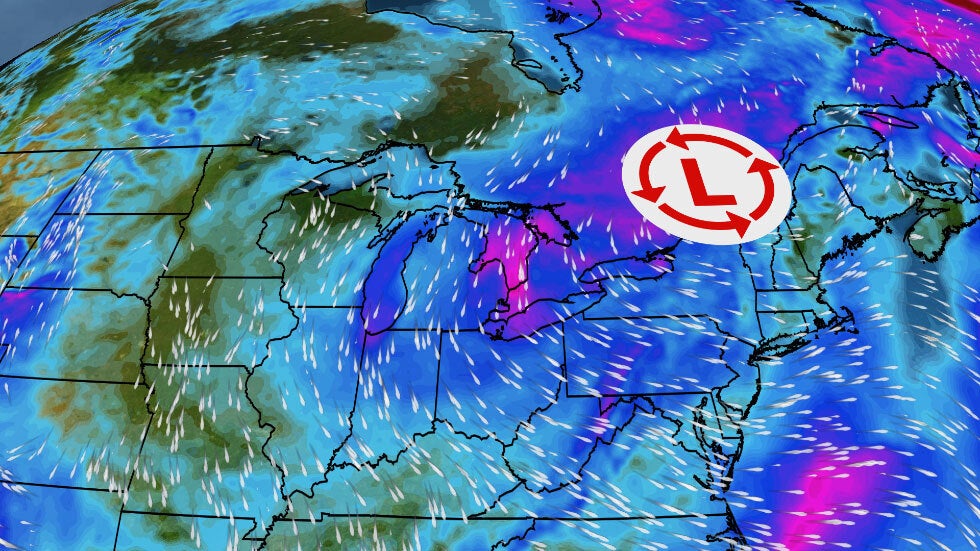
A sprawling dome of surface high pressure currently bridges south-central Canada and the northern Great Lakes region with the eastern periphery nosing into the Northeastern United States, responsible for the very chilly air entrenched over the northern third of the US at present. Meanwhile, a series of Pacific disturbances carrying the remnants of once Super Typhoon Melor are riding a fast (120-140kts) zonal jet stream centered near 40°N across the country. As this energy reaches the East Coast a northern stream shortwave will begin to sharpen a trough over the Eastern US causing low pressure to deepen while moving up the coast. This will spread a variety of precipitation types across the Northeastern US, along with wind and coastal flooding. Across the interior elevated terrain, there may be some hefty early-season snowfall accumulations. Then, not to be outdone, the northern stream shortwave which causes the buckling of the jet will form its own coastal low pressure as it crosses the Appalachians. This will continue the unsettled weather along the coast as a second area of low pressure forms and sticks around through the weekend.
Remainder of forecast here
Not likely, since we depend on norther Sierra snowpack for much of our water.
Viewing: 451 - 471
Page: 1 | 2 | 3 | 4 | 5 | 6 | 7 | 8 | 9 | 10 — Blog Index