Satellite data and measurements from the Hurricane Hunters show that Irene is weakening. A 9:21 am EDT center fix by an Air Force Reserve aircraft found that Irene's eyewall had collapsed, and the central pressure had risen to 946 mb from a low of 942 mb this morning. The highest winds measured at their flight level of 10,000 feet were 125 mph, which would normally support classifying Irene as a Category 3 hurricane with 115 mph winds. However, these winds were not mixing down to the surface in the way we typically see with hurricanes, and the strongest surface winds seen by the aircraft with their SFMR instrument were just 90 mph in the storm's northeast eyewall. Assuming the aircraft missed sampling the strongest winds of the hurricane, it's a good guess that Irene is a mid-strength Category 2 hurricane with 100 mph winds. Satellite imagery shows a distinctly lopsided appearance to Irene's cloud pattern, with not much heavy thunderstorm activity on the southwest side. This is due to moderate wind shear of 10 - 20 knots due to upper-level winds out of the southwest. This shear is disrupting Irene's circulation and has cut off upper-level outflow along the south side of the hurricane. No eye is visible in satellite loops, but the storm's size is certainly impressive. Long range radar out of Wlimington, North Carolina, shows that the outermost spiral bands from Irene are now beginning to come ashore along the South Carolina/North Carolina border. Winds at buoy 41004 100 miles offshore from Charleston, SC increased to 36 mph as of 10 am, with significant wave heights of 18 feet.

Figure 1. Distribution of Irene's wind field at 9:30 am EDT Friday August 26, 2011, as observed by the Hurricane Hunters and buoys. The right front quadrant of the hurricane had about 90% of the storm's hurricane-force winds (yellow and warmer colors, bounded by the heavy black line between the "50" and "60" knot thin black lines.) Tropical storm-force winds (heavy black like bounding the light blue area) extended out 290 miles from the center of Irene. Image credit: NOAA/AOML/HRD.
Forecast and storm surge potential for Irene
With its eyewall collapsed and just 24 more hours over water before landfall, it is unlikely Irene will have time to build a new eyewall and intensify. The storm is too large to weaken quickly, and the best forecast is that Irene will be a Category 2 hurricane at landfall in North Carolina on Saturday, and a rapidly weakening Category 1 hurricane at its second landfall in New England on Sunday. However, since Irene is such a huge storm--tropical storm force winds extend out up to 290 miles from the center--it has set a massive amount of the ocean's surface in motion, which will cause a much larger storm surge than the winds would suggest. At 9:30am EDT this morning, a wind analysis from NOAA/HRD (Figure 1) indicated that the potential storm surge damage from Irene rated a 5.1 on a scale of 0 to 6. This is equivalent to the storm surge a typical Category 4 hurricane would have. While this damage potential should gradually decline as Irene moves northwards and weakens, we can still expect a storm surge one full Saffir-Simpson Category higher than Irene's winds. Since tides are at their highest levels of the month this weekend due to the new moon, storm surge flooding will be at a maximum during the high tidal cycles that will occur at 8 pm Saturday night and 8 am Sunday morning. Wherever Irene happens to be at those times the storm surge damage potential will be maximized. A surge rivaling that experienced during Hurricane Isabel in 2003 is likely in northern NC, southern Maryland, and up Chesapeake Bay on Saturday night. Coastal New England from New York City to Massachusetts may also see storm surges characteristic of a Category 1 hurricane during Sunday morning's high tide, even if Irene has weakened to a tropical storm. I continue to give a 20% chance that a storm surge high enough to over-top the Manhattan flood walls and swamp the New York City subway system will occur on Sunday.
Wind damage
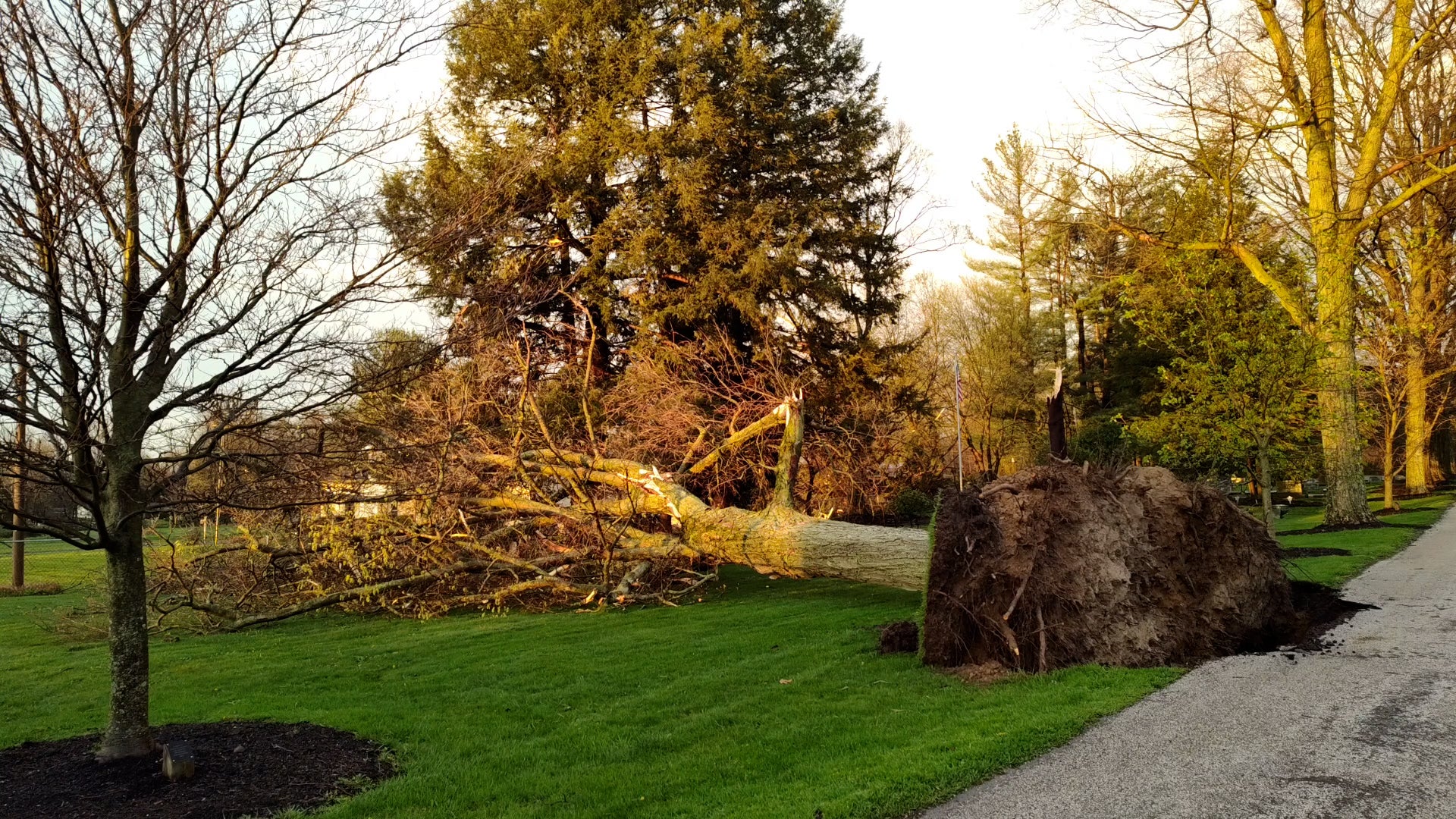
I don't think Irene is going to do a lot of wind damage to the mid-Atlantic states, since the eye of the storm will be just offshore, and the I-95 corridor from Virginia to New Jersey will be on the weak (left) side of the hurricane. The current wind distribution of Irene (Figure 1) shows almost all of the hurricane's winds are on the right side of the storm, and by the time the storm reaches Virginia, there will be likely be no hurricane-force winds on the left side of Irene. Sustained winds should stay below 74 mph (hurricane force), and wind damage will be similar to that wrought be some of the strongest Nor'easters of the past 20 years, from Virginia northwards to New York City. Since Irene will be steadily weakening as it approaches its second landfall on Long Island, I give a 50% chance that no mainland U.S. surface station in New England will record sustained hurricane-force winds. I do think it likely that one or more of the offshore islands--Block Island, Nantucket, and Marthas Vinyard--will get Category 1 hurricane winds. Though the wind damage to buildings will be similar to what the Northeast has seen during some of the more severe nor'easters of the past 20 years, tree damage will be much worse. The trees are in full leaf during hurricane season, and catch the wind much more readily than during the winter. Tree damage will very heavy, and we can expect trees in regions with saturated soils will fall over in high winds onto power lines. Irene is likely to cause one of the top-five most widespread power outages in American history from a storm. The record power outage from a Northeast storm was probably the ten million people that lost power during the great Blizzard of 1993. I don't think Irene's power outages will be quite that extensive, but several million people will likely lose power.
Irene likely to bring destructive fresh water flooding
In addition to storm surge, flash flooding and river flooding from Irene's torrential rains are the main threats. The hurricane is expected to bring rains in excess of 8" to a 100-mile-wide swath from Eastern North Carolina northwards along the coast, through New York City. The danger of fresh water flooding is greatest in northern New Jersey, Southeast Pennsylvania, and Southeast New York, where the soils are saturated from heavy August rains that were among the heaviest on record. New Jersey has had its 6th wettest August on record, with most of that rain falling in the past two weeks. Expect major river flooding throughout New Jersey the Delmarva Peninsula, and regions near New York City, as Irene's rains run off the saturated soils directly into the rivers. In general, the heaviest rains will fall along the west side of the hurricane's track, and the greatest wind damage will occur on the east side. I don't think flooding from heavy rains will be a huge concern in North Carolina, which is under moderate to severe drought. Irene's rains are likely to do some good in Southeast Virginia, where a fire triggered by lightning from a thunderstorm on August 4 sparked a fire in the Dismal Swamp that is burning out of control. Right now, it does not appear that tornadoes will be a major concern, but there will probably be a few weak tornadoes. Hurricane Bob of 1991, the last hurricane to affect New England, spawned six tornadoes, most of them weak F-0 and F-1 twisters.

Figure 2. Predicted rainfall for the 5-day period ending at 8 am EDT Wednesday August 31, as issued by NOAA/HPC.
Links
For those of you wanting to know your odds of receiving hurricane force or tropical storm force winds, I recommend the NHC wind probability product.
Wunderground has detailed storm surge maps for the U.S. coast.
The National Hurricane Center's Interactive Storm Surge RIsk Map, which allows one to pick a particular Category hurricane and zoom in, is a good source of storm surge risk information.
Wunderblogger Mike Theiss is in Nassau, documenting the storm's impact on the Bahamas.
Internet radio show on Irene at 4:30pm EDT
Wunderground meteorologists will be discussing Hurricane Irene on a special edition of our Internet radio show, the Daily Downpour, today (Friday) at 4:30pm EDT. Shaun Tanner , Tim Roche, Angela Fritz, and Rob Carver will there, and I will be available if my schedule permits. Listeners can email in or call in questions. The email address to ask questions is broadcast@wunderground.com.
Portlight mobilizes for Irene
The Bahamas have been hit hard by Irene, and unfortunately, it appears that the Northeast U.S. may have its share of hurricane victims before Irene finally dissipates. My favorite disaster relief charity, Portlight.org, is mobilizing to help, and has sent out their relief trailer and crew to North Carolina. Check out this blog to see what they're up to; donations are always needed.
Jeff Masters
A shot of the Palm Trees at Nassau, Bahamas being thrashed by high winds during Irene's closest approach !
Aftremath of Hurricane Irene in Nassau, Bahamas (
ktbahamas)
Utility pole with street light snapped in half by Irene's winds on a busy street in New Providence.
Portlight deploying to North Carolina
Page: 1 | 2 | 3 | 4 | 5 | 6 | 7 | 8 | 9 | 10 | 11 | 12 | 13 | 14 | 15 | 16 | 17 | 18 | 19 | 20 | 21 | 22 | 23 | 24 | 25 | 26 | 27 | 28 — Blog Index
Signal #4 raised in Cagayan.... no serious damage reported on the news but may get reported tomorrow or as it leave PAR.
Easy Bob, sounds like you starting to loose it! :p
I think in terms of how many people are affected, it will be a bit worse than Bob or Gloria. Gloria hit southeastern New England and caused some decent damage in that area, but I lived a mere 40 miles from landfall and all we got was a couple thunderstorms and some steady rain that added up to under 2 inches. Bob took a similar path and all I got was overcast skies and sprinkles. So I think this storm is a lot more serious in terms of how widespread it will be.
*All graphics can be magnified by clicking on them (they can also be further magnified in the new window by clicking on the graphic)
As of yesterday that all changed and he was out of there (Mandatory Evacuation) so people are taking this seriously. It will be interesting to see how the Piers deal with this storm.
I know amusement parks and roller-coasters are not a primary concern but I have really enjoyed Morey's, Steel Pier and the rest of the rides along the Jersey Shore. This will be a terrible economic impact to have this happen right before Labor Day.
I am hoping for the best for everyone in the path of Irene and I really hope the worst case scenario does not occur for New York City and the rest of the North East this weekend.
Oh there is "your" and "you're", "their" and "they're", "its" and "it's", and the list goes on...
Hopefully it's just because they're lazy and not because they're uneducated...
Video games.
My advice for Northeast coast residents for Irene is this: Think of the worst storm in your local area. This one will be worse.
Maybe the 20 mile stretches where the eye of Bob and Gloria made landfall won't have a worse storm. Maybe Battery Park won't be as bad as 1992. But everywhere else it will be worse.
The model done an incredible job so far and they call for a weakening and gain before landfall if i understand that right.
Hey P,
It's not to late to add more cheetos and slim-jims to the supply kit.
What are your thoughts on Irenes current state?
Well he sure as heck downcasted this thing. I am giving this thing until a few hours to NC to see if it re-intensifies (it might, these hyped forecasters may have just lost patience with "the worst storm since 1938"). NC is my benchmark. If it hits NC at less than 100mph, my guard is officially down for NYC/Long Island!
Oh I totally agree, but they were predicting Cat 4, not a Cat 2. And that makes a huge difference, no?
n txtng
I agree with you that Irene is still very much a threat but she going downhill, and maybe in a hurry. HH will tell us the tell on the next couple hrs. She's already went from 115 to 105 today. So she's already showing that trend and her WV, Shortwave and AVN loops are all pointing to a collasped core. Anyone have a Microwave Sat pass of her?
It's more towards texting.
Mine too.
Hitting N Carolina should weaken it enough and disrupt the surge substantially before it emerges back over water.
I hope this image of a deteriorating storm does not give coastal residents a false since of security. The winds can come down some fairly quickly; but the storm surge she brings is still going to be awfully nasty.
I'd paddle out in that thing. Well am about paddle back out down here in windy Cocoa area. Cat 1 and 2, ride those out in my house and the kooks from TWC will probably be out on the beach when this rolls through or hanging in their motorhome staying dry between shots at or on the beach somewhere. Cat 3 is when start to worry, unless you live on an island and your house is about 5to 10 foot about sea level like we saw at Galvestin in Ike and one of my places in Navarre during Ike which ended up in the sound when surge when completely across the island. If your in a safe structure, cat 1 or 2 not bad. Just no A/C and unsafe water for days and days tends to suck afterwards.
I know very little, but I know more than all at the Weather Channel. They're just selling stuff.
actually, "lose" is spelled kinda funny. I mean look at "close", using that pronounciation we should pronounce "lose" as "lowz" or maybe "lowce". It would make more sense to spell "lose" as "looze" or maybe "luze".
So I can see why a lot of people make that mistake, especially when typing fast. In fact when you think about it, it's downright silly the way "Lose" is spelled. I mean, the only difference in the way "Lose" and "Loose" are pronounced is the "S" or "Z" sounds, so let's just change the number of "O"s, yeah that makes sense.
I'm putting the over/under at 14 days.
NBC's Peter Alexander reports from Biloxi, Mississippi where he joined a crew of hurricane hunters on an 11-hour flight that took them into the eye of Hurricane Irene to learn more about the storm's strength and potential threat.
Visit msnbc.com for breaking news, world news, and news about the economy
Ike's eyewall collapsed as well but it maintained it's Cat 2 strength and Cat 4 Storm Surge across the western gulf. That energy doesn't stop on a dime.
Irene will remain a coastal and inland issue up the east coast.
TWC has been in a downward spiral for a couple of years now. How about Die-rene instead of Dryrene?
Agree completely.
(Reuters) - President Barack Obama on Friday warned Americans to take Hurricane Irene seriously and urged them to obey orders to evacuate from the path of what is likely to be an "extremely dangerous and costly" storm.
"All indications point to this being a historic hurricane," Obama said in a statement to reporters from the farm where he is vacationing on this island off the Boston coast.
Fifty-five million people are potentially in Hurricane Irene's path, from the Carolinas to Cape Cod on the East Coast, and tens of thousands are evacuating as cities including New York and Washington brace for the powerful storm to hit. http://www.reuters.com/article/2011/08/26/us-stor m-irene-obama-idUSTRE77P4IM20110826
Viewing: 151 - 201
Page: 1 | 2 | 3 | 4 | 5 | 6 | 7 | 8 | 9 | 10 | 11 | 12 | 13 | 14 | 15 | 16 | 17 | 18 | 19 | 20 | 21 | 22 | 23 | 24 | 25 | 26 | 27 | 28 — Blog Index