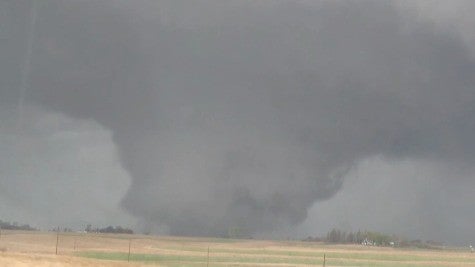
Widespread and potentially catastrophic areal flooding and river flooding is expected this afternoon through Wednesday morning in Eastern Oklahoma, Western Arkansas, Western Louisiana, and Southwest Missouri, warns the National Weather Service in Tulsa, Oklahoma, in their latest flood watch for the region. The storm system responsible is a massive, slow-moving trough of low pressure over the Western U.S. that dumped heavy snows that closed several interstate highways in Arizona over the weekend. This storm system will collide with the warmest and moistest air mass ever recorded in March in the Central and Eastern U.S. According to the NWS in Minneapolis, Minnesota, moisture flowing northwards into Minnesota along the cold front yesterday had the highest levels of moisture ever recorded so early in the year, and moisture levels are expected to remain at record levels today. At the boundary between the Western U.S. trough of low pressure and Central U.S. ridge of high pressure, a cold front will lift huge quantities of moisture-laden air aloft, forcing record rains to fall. A wide region of 4 - 8 inches of rain is expected in the flood watch area, and isolated amounts as high as 15 inches could fall by Wednesday, as numerous rounds of thunderstorms repeatedly track over the same area. The cold front is also expected to trigger a Moderate Risk of severe weather over much of Texas today, including the Dallas-Fort Worth area, says NOAA's Storm Prediction Center. Damaging winds, large hail, flash flooding, and few strong tornadoes are expected to affect the area late this afternoon. Severe thunderstorm watches are already posted for much of West Texas, as seen on our Severe Weather Map. Eleven tornadoes were reported yesterday in Oklahoma, Nebraska, and South Dakota.

Figure 1. Predicted rainfall amounts for the 3-day period Monday morning through Thursday morning show an area of 7+ inches (yellow colors) is expected over Eastern Oklahoma, Western Arkansas, Western Louisiana, and Southwest Missouri. Image credit: NOAA HPC.

Figure 2. NOAA's Storm Prediction Center has highlighted a Moderate Risk area for severe weather over much of Texas today, including the Dallas-Fort Worth area.
Summer in March for the Midwest
The ongoing March heat wave in the Midwest is one of the most extreme heat events in U.S. history. With so many records being shattered, it is difficult to cover in detail just how widespread, long-lasting, and extreme the event is, and I offer just a few highlights:
Winner, South Dakota hit 94°F yesterday, the earliest 90°+ reading ever recorded in the Northern Plains, according to wunderground's weather historian, Christopher C. Burt. The 94°F reading was just 2°F short of the all-time state record for South Dakota in March, which was 96°F in Tyndall in 1943. However, subsequent analysis by NOAA questioned this 94°F reading, and it is now believed that 87°F is the appropriate high for Winner.
International Falls, Minnesota hit 79°F yesterday, the hottest March temperature on record in the Nation's Icebox. At midnight this morning, the temperature was 66°F there, breaking the record high for March 19 (set in 1910) by 6°F. The low temperature for International Falls bottomed out near 60°F this morning, so low for today is (unofficially) the same as the previous record high for the date. This is the seventh consecutive day that International Falls has broken or tied a daily record. That is spectacularly hard to do for a station with a century-long weather record. The longest string of consecutive records being broken I'm aware of is nine days in a row, set June 2 - 10, 1911 in Tulsa, Oklahoma (with weather records going back to 1905.) International Falls has a good chance of surpassing nine consecutive records this week.
Houghton, Michigan, near the frigid shores of Lake Superior, hit 76°F both Saturday and Sunday. It was the hottest March temperature on record, and an astonishing 44°F above the average high for the date (Saturday) of 32°. Huron, South Dakota also recorded a high temperature (88°F) that was 44° above the average high for the date, on Sunday. Most of the cities in Northern Michigan set all-time March high temperature records over the weekend.
Chicago, Illinois now has a string of five consecutive days of 80°+ temperatures, and the hottest temperature on record for so early in the year (82°F on Friday, and tied again on Saturday). The average high temperature in August is 82°F in Chicago, so this week is basically summer weather. Prior to this year, there had only been 10 days in March with highs in the 80s in Chicago, going back to 1871. The last time Chicago saw an 80 degree temperature during the month of March (prior to this year) was over 22 years ago back on March 12, 1990 when the high temperature hit 81. This morning's Public Information Statement from the National Weather Service in Chicago had this to say about this unprecedented March heat:
Chicago and Rockford have now both broken high temperature records 5 days in a row. There is even the potential they could tie or break record highs for up to an unbelievable 8 days in a row depending on how warm temperatures get Monday through Wednesday. It is extraordinarily rare for climate locations with 100+ year long periods of records to break records day after day after day.

Figure 3. March's month-to-date average temperature compared to the other top 5 warmest months of March in Chicago. The dotted blue lines are month-to-date average temperatures based on the current predicted temperatures. The hashed black line is the average month to date temperature for March. These graphs really illustrate just how far above the previous warmest top 5 Marches this month really has been and assuming no major pattern change the last week of the month gives some indication of just how far above the record March 2012 could end up being. Image credit: NWS Chicago.
Record heat in Canada
Record-breaking heat has also penetrated into the Prairie provinces of Canada over the past week. Winnipeg, Manitoba broke its record high for the past four days in a row, and hit 21°C yesterday, its hottest temperature on record so early in the year. With today's forecast by Environment Canada and wunderground both calling for highs near 25°C (77°F), Winnipeg is likely to record its highest March temperature on record. Previous record: 23.3°C on March 27, 1946. The earliest date for a 25°C+ temperature in Winnipeg is April 9, 1977.

Figure 4. The jet stream pattern features a large, southwards dipping bulge over the Western U.S., creating a trough of low pressure with cold and snow, and a large, northwards looping bulge over the Central U.S., creating a record-strength ridge of high pressure.
Why the record early-season warmth?
The unusual warmth is due to a loop in the jet stream that has created a large upper-level ridge of high pressure that is stuck in place over the Eastern U.S.--a phenomenon known as a "blocking pattern." Since the jet stream acts as the boundary between cold air to the north and warm air to the south, and the large loop in the jet places its axis far to the north of the eastern U.S., summer-like warmth has developed over the eastern half of the U.S. Conversely, colder than average temperatures have developed over the western third of the U.S. behind the southwards-dipping loop of the jet stream. There are at least three large-scale patterns working together right now to create an unusually strong ridge over the eastern half of the U.S.:
1) La Niña. The on-going La Niña event in the Eastern Pacific has weakened considerably over the past month, but ocean temperatures there are still cool enough to affect the jet stream pattern, favoring high pressure and warm temperatures over the Eastern U.S., and low pressure and cold temperatures over the Western U.S.
2) The Madden-Julian Oscillation( MJO). The MJO is a 2-month cycle of thunderstorm activity that travels west to east along the Equator. The MJO is currently in phase with La Niña, and is helping create warmer temperatures over the Eastern U.S.
3) The North Atlantic Oscillation (NAO.) The NAO is in its positive phase, which means the difference in pressure between the Icelandic Low and the Azores High is stronger than usual. This tends to increase the jet stream winds and keeps the jet from sagging southwards over the Eastern U.S.
While the blocking pattern responsible for the heat wave is natural, it is very unlikely that the intensity of the heat would have been so great unless we were in a warming climate. Climate scientist Dr. James Hansen has posted an interesting (as yet unpublished) paper discussing how the odds of such extreme heat events have shifted in recent years.
Extreme jet stream patterns like this often lead to tornado outbreaks in the Midwest, at the boundary of where warm, moist air flowing north from the Gulf of Mexico collides with cold, dry air flowing south. Cold dry air aloft, combined with warm, moist air at the surface, makes the atmosphere unstable, since air rising in thunderstorm updrafts will be less dense than the surroundings, allowing the air to accelerate upwards and increase the intensity of the thunderstorm. This will be the case today, when NOAA's Storm Prediction Center has highlighted a Moderate Risk area for severe weather over much of Texas today, including the Dallas-Fort Worth area.
Flood risk low this year for the Northern Plains
For the first time in four years, the Northern Plains are not expecting major to record snow melt flooding, said NOAA's National Weather Service in their annual spring flood outlook issued last week. Residents along the Mississippi, Missouri, Red, and Souris Rivers have endured a punishing series of bad flood years, but this year is unlikely to continue that trend, due to a lack of snow cover. The Northern Plains states of Minnesota, Wisconsin, North Dakota, and South Dakota recorded their 3rd - 8th warmest winter in the 117-year record, and are on pace to crush the record for warmest March in history. Winter snowfall was below average over most of the region, and what snow was on the ground at the beginning of March has mostly melted, thanks to the record-breaking March heat this week. The Souris and Red River basins contain about one-third the amount of water in the snow as last year, ranking this season in the lower half of the last 60 years. Precipitation this water year (since Oct 1, 2011) has been less than 50% of the normal across the Upper Mississippi and Upper Missouri Valleys, and much of the region is under moderate to severe drought, according to the latest Drought Monitor.

Figure 5. What a difference a year makes! Snow cover on March 15 of last year (top) was heavy over Minnesota, Wisconsin, and the Dakotas, and caused massive flooding problems on the Mississippi and Missouri Rivers during spring melt season. In contrast, there is almost no snow pack in the Upper Midwest this year (bottom), significantly reducing the odds of spring flooding on the Missouri and Mississippi Rivers. Image credit: NOAA/NOHRSC.

Figure 6. The U.S. spring flood risk, as predicted by the National Weather Service on March 15, 2012.
Jeff Masters
Today it was warm, sunny & calm water with clouds matching the mood of the people just enjoying this view.
I pulled a piece of ice out of Mullet Lake in Northern Michigan during my bike ride along the shore. It was so strange riding shirtless in 82°F heat along the shore of a frozen lake. The ground still had some snow patches from the 16" snow storm from last week. The lake ice is breaking up weeks ahead of usual due to our warm winter and incredible March heat.
Come have a glass of wine on the patio! (
RedRoxx)
LOL woke up to MORE snow, in the VOC (Sedona) are today, want to have a drink on the patio with us?
End of the Icefishing Season (
bbend)
One last beautiful day on the ice but it's beginning to weaken and get unsafe- another 60 plus degree day. Normally we'd have about 3' of ice or more but this season it was about 24" at the most.
Page: 1 | 2 | 3 | 4 | 5 | 6 | 7 | 8 | 9 | 10 | 11 | 12 | 13 | 14 | 15 — Blog Index
Good ol Hearne, TX. I just moved to Dallas from Franklin so I know that area well. Good luck on catching a decent storm today. I'm hoping to see one myself, only from the view of my office window in downtown.
Here's an update from KVUE Meteorologist Mark Murray: It's been several years since we've seen this great of a risk of severe weather in Central Texas. The Storm Prediction Center has placed the Austin area in a Moderate Risk, which is rather unusual for us. Starting around 6:00 pm tonight, we could see severe storms which may contain large hail of 1"-2" in diameter, damaging winds, and tornadoes. Strong tornadoes are possible in this type of situation. After midnight, we'll see an increased risk of flash flooding as the rain continues. Many areas could see 2"-4" with isolated totals of 5"-6", especially north and northeast of Austin. Things should settle down around 6:00 am Tuesday. It will be very important to keep track of the weather tonight. And I would appreciate your reports here on Facebook, especially reports and pictures of large hail, flooding, and of course tornadoes, but only if you can do so safely. The best place to send pictures would be to spotnews at KVUE dot com. It's going to be a long night!!
Pretty strong langugage from Dr. Murray...he is usually the conservative, reserved Austin area forecaster!
Former President George W. Bush announced today he will become an outspoken climate change advocate. He became alarmed when a large chunk of ice fell off his mother.
Correct, but the first chore is to get people to pay attention to what has already happened.
We don't have a way to quickly return things back to the good old days of a couple decades ago. The choice we have is all about how much worse we allow things to get.
I'll be home in 45 minutes and will give a more detailed post then.
The only fly in the ointment is if an El Nino were to rapidly develop, as that could have significant implications on the path of the jet stream preventing the upper-level ridge from becoming very firmly entrenched & self-perpetuating.
George Bush is a heck of alot better person then you will ever be. A truely good person has no need to bash others. Keep that in mind next time you try to bring yourself lower with comments such as that.
Wow! That was a huge splash
Surprisingly, the La Nina has strengthened over the past two weeks.
Hey nigel wats up
Sheesh, I'm a card carrying Republican and I found what press said hilarious.
Calm down, let it go and stay on weather.
Very unhealthy
More like stayed about the same which is key because if this stays as is or warms slightly to nuetral then we could end up with an interesting hurricane season.
From Levi32
The trade winds are holding strong in the central Pacific so far, but the anomalous westerlies in the eastern Pacific are starting to fade as we enter a generally neutral ENSO state
I dont get it.
After reading the opening paragraphs, I cant help thinking it sounds like the dialogue for a movie trailer about Armageddon.
That's quite some cooling since march 1
Barbara Bush has been frequently stereotyped as something of an Ice princess...although I must say: I have a very close friend who was on her Secret Service detail...and he says she was totally lovely...even baked cookies for the agents...
Nino 3.4 stays at -0.6C on todays CPC update,same as last week's update.
Link
Nah, it has definitely strengthened. Look at post #77.
Uhm....no thank you! LOL!
What??
Two weeks are not much to go on. The datasets are always noisy, progressing in steps. If we get through mid-April with no appreciable warming, then that will be more interesting.
He said he hopes not.
I think he just meant this was interesting to him.
I'm good....how have you been?
Ugh yeah looks like San Antonio is going to end up getting a few sprinkles...again.
Thanks much
Where do you see it has strengthened? Do you mind sharing this with me please..:D
Peyton Manning going to the Broncos.
YES!!!!!!!!!!!!!!!!!!!!!!!!!!! :):)
i nailed the one under the + sign(radar site)
I seen VIL showing a reflectivity of 45, and I had remembered seeing that the NWS thinks about a warning(most of the time) when it hits 40, so i was wondering if a warning would go out.
#3 time i knew a storm was severe before a warning went out :D
And out goes TT.
Link
no.....:(:(:(:(
I seen that if they got him, they would release my main man Tim Tebow next year! :(
:(
Or a beer!
There may be dozens of daily records broken today by margins of 15-20 degrees or more.
It's crazy nonetheless. Never expected to be so uncomfortable wearing just a hoodie and a T-shirt for late March while walking home. :/
Viewing: 101 - 151
Page: 1 | 2 | 3 | 4 | 5 | 6 | 7 | 8 | 9 | 10 | 11 | 12 | 13 | 14 | 15 — Blog Index